
· Tess Brandow
How to store homemade bread
The first loaf people bake at home is usually eaten the same day, so nobody notices the problem. It turns up on the second bake, when half a loaf is left over and hard by Wednesday. That is not a fault in the recipe. It is what bread does when nothing has been added to stop it.
Why yours ages faster than a shop loaf
A supermarket sandwich loaf contains emulsifiers and enzymes whose whole job is to delay the crumb firming up. They work. A loaf made from flour, water, salt and yeast has none of them, and the difference shows on day two rather than day five.
That is worth knowing because it reframes the question. You are not trying to match a shop loaf's shelf life. You are trying to get three good days out of something that was never built for seven.
Room temperature, and a bag that breathes
The counter is the right place for the first two or three days. What the loaf needs there is a slower exchange of air across its surface — enough to keep the crumb from drying, not so little that steam collects on the crust.
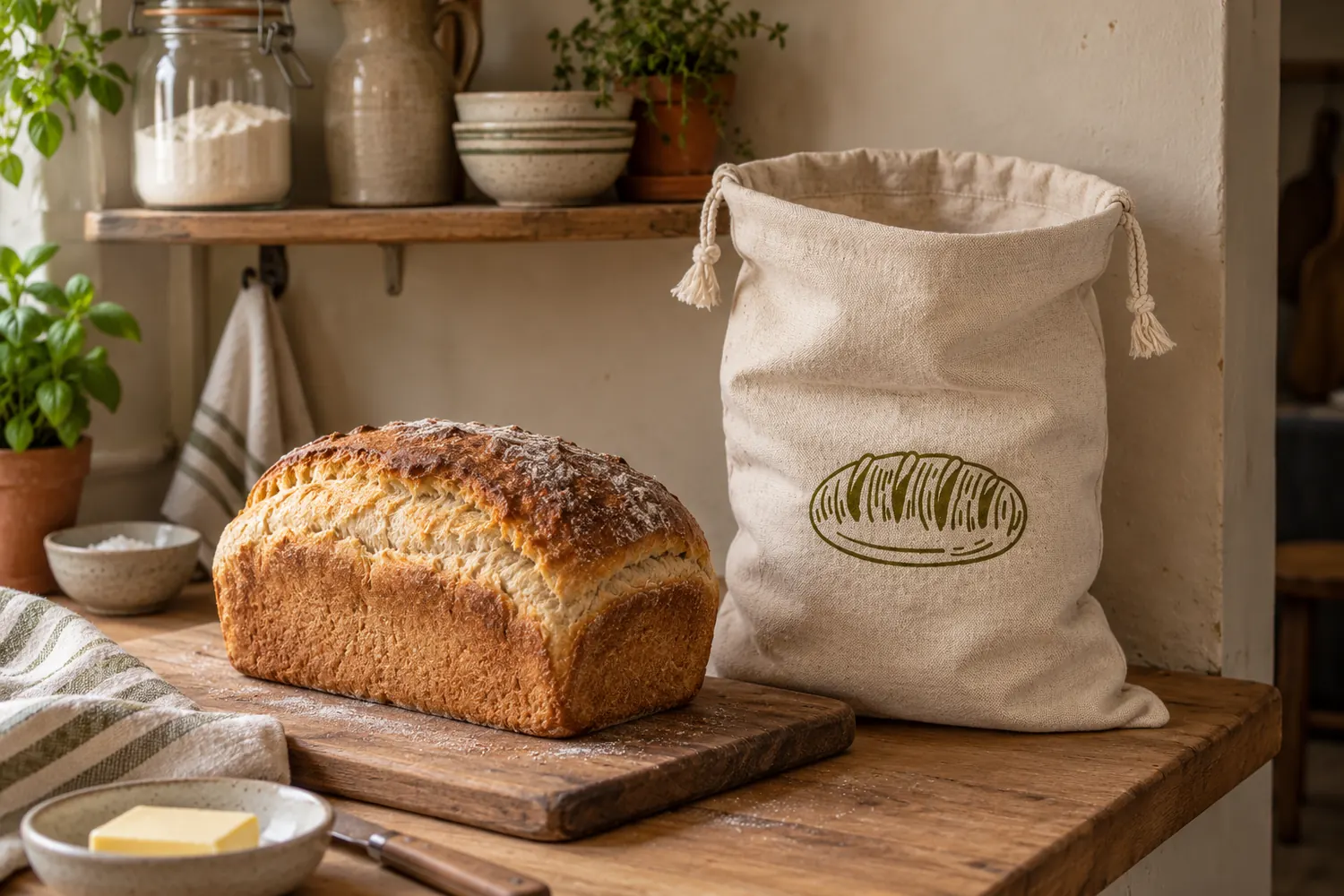
A close-woven cloth bag does that, and so does a bread box. Both work for the same reason: they hold a small pocket of slightly humid air around the loaf without sealing it. A plastic bag seals, and a sealed loaf goes soft-crusted and, by day three, mouldy sooner rather than later.
A cut loaf needs its cut face protected
Whatever you keep the loaf in, stand it on its cut face. That one habit does more for a half loaf than the choice of bag. The crust is a barrier the loaf grew for itself; the cut is the hole in it, and a wooden board closes the hole.
Where in the kitchen to put it
The spot matters more than people expect, because every one of the problems above is driven by temperature and moving air. Keep the loaf away from the hob, out of direct sun through a window, and off the top of the fridge, which is the warmest surface in most kitchens and the one people reach for first. A shaded corner of the worktop at room temperature is the right place, and it is worth keeping the bread board and the bag there together so the routine happens without thinking about it.
The freezer, done properly
Anything past three days should go in the freezer on the day it is baked, not on the day it starts to go hard. Freezing stops the staling process where it stands — it does not reverse what has already happened.
Slice first, freeze the slices flat, then bag them. Toast them from frozen. A loaf treated this way on baking day is better on Friday than a loaf left on the counter is on Wednesday.
How long each method actually buys you
On the counter in a cloth bag, a plain white or wheat loaf is good for two to three days and usable for four. A rye or a high-hydration sourdough runs a day longer, because more water in the crumb means more to lose before it feels dry. An enriched loaf — milk, butter, egg — also goes longer, and goes mouldy sooner.
In the freezer, sliced, three months is a reasonable outer limit before the texture starts to suffer. Nothing goes wrong at three months and a day; it simply gets gradually less good.
The end of the loaf, and what it is for
A home-baked loaf has a second life that a shop loaf mostly does not, because it has no additives in it and it dries rather than going sour. Day four is not the end of it; it is the point where the bread stops being for sandwiches and starts being for something else.
Toast is the obvious one and the most underrated. Heat reverses starch retrogradation, so a slice that felt firm and dry comes out of the toaster genuinely soft again. A loaf too firm to slice thinly will still slice thickly, and thick toast is not a consolation prize.
Croutons and breadcrumbs take a loaf that is beyond slicing. Cubes tossed in oil and baked low keep for weeks in a jar; crumbs from a food processor freeze loose and go straight from the freezer into a crumble topping or a meatball mix.
The dishes built on stale bread are worth knowing because they are better with it than with fresh: panzanella, ribollita, French toast, bread pudding, a pangrattato over pasta. Fresh bread turns to paste in all of them. Firm bread holds.
None of that is a reason to let a loaf go hard on purpose. It is a reason not to throw one away on Thursday because it is no longer Monday’s bread. And it is worth saying plainly: the day a loaf shows any fuzzy spot, the whole loaf goes, second life or not.
Two habits worth dropping
The first is the fridge, for the reasons in the previous section: the cold speeds up the exact process that makes bread hard. The second is storing bread warm. A loaf bagged before it is cold sweats, and a sweating loaf goes mouldy in half the time.

Tess Brandow · Home baker — she writes the guides on this site
Tess has baked the household’s bread for about fifteen years, two loaves most weeks, in an ordinary kitchen with an ordinary oven. She is not a professional baker and does not run a bakery. What she has is a long run of the same problem: a loaf that is worth eating on Monday and disappointing by Wednesday.