
· Tess Brandow
Beeswax bread bags and woven cloth: what each one does to a loaf
These two get shelved together and sold side by side, and they behave like opposites. Both are cloth, both are reusable, both are pitched at the same person trying to stop buying plastic. But one of them has been deliberately closed and the other has deliberately been left open, and that single difference decides which loaf each one is good for. Here is what the wax actually changes.
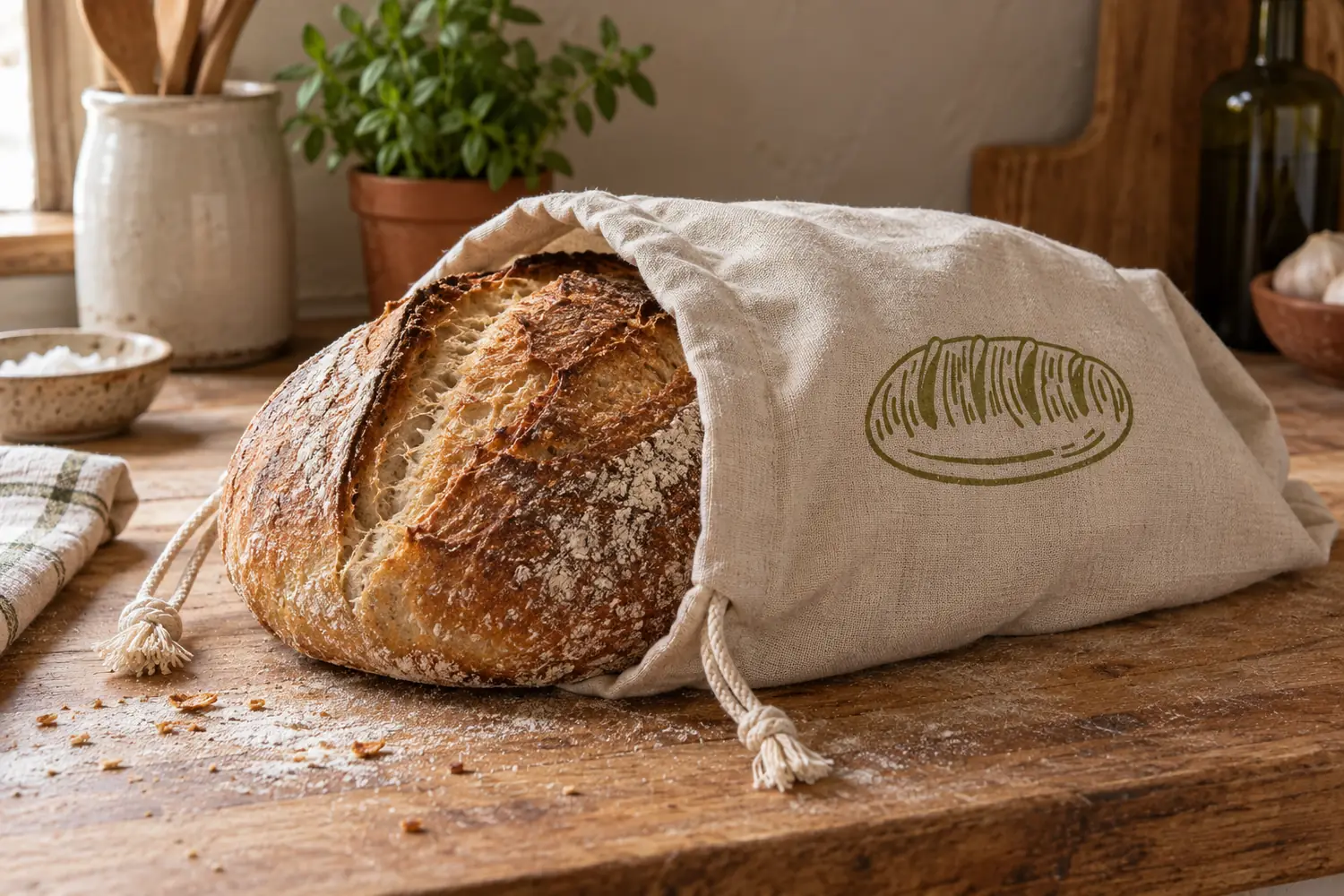
What the wax actually does
A waxed cloth starts as ordinary fabric and is coated with a mixture built around beeswax, usually with an oil and a tree resin to keep it pliable. The coating fills the gaps between the threads. That is the entire point of it: the cloth stops being a mesh and becomes a sheet, one that can be pressed into a fold and will hold that fold by itself.
A sheet that holds a fold is a barrier. Moisture that leaves the bread cannot get past it, so it stays in the bag as humid air and settles back on whatever surface is coolest. For something with no crust to protect — a soft crustless loaf, a cut cake, a half onion — that is exactly the behaviour you want, and it is what the material was designed around.
What an open weave does instead
An uncoated cloth keeps its mesh. Air moves through it, slowly, because the threads are close together but not sealed. A loaf inside it is doing two things at once: giving off the last of its steam, and slowly losing water from the crumb to the air. The weave lets the first happen and slows the second, which is the whole trick.
The visible result is a crust that stays crisp. A crust is a dried, hardened shell that took forty minutes of oven to build. Put it in a sealed environment and its own steam condenses on it overnight and softens it back to leather. Leave the cloth open and the steam goes, and the crust is still a crust in the morning.
Side by side
| What happens | Waxed cloth | Uncoated woven cloth |
|---|---|---|
| Crust after one night | Softened, slightly leathery | Still crisp |
| Crumb on day two | Soft and moist | Firms up slowly |
| Condensation inside | Likely, especially if the loaf went in warm | None |
| Washing | Cool water by hand; heat melts the coating | Warm machine wash with the tea towels |
| Over time | The coating wears and needs renewing | The cloth softens and keeps working |
| Suits | A soft crustless loaf, or food that should not breathe | Anything baked with a crust on it |
The last row is the one that decides it. A waxed cloth suits a soft loaf with no crust to protect, the same way a plastic bag does and for the same physical reason. It is the wrong tool for anything that came out of an oven with a crackle on it.
Washing is where the two really part
This is the practical difference that shows up within a fortnight of ownership, and it gets very little attention at the point of sale.
Wax melts. That is not a flaw, it is what wax is, and it means a waxed cloth has to be washed in cool water by hand and kept away from anything hot. Hot water, a dishwasher or a warm machine cycle will move the coating around and thin it in patches.
An uncoated cloth has no such constraint. Shake the crumbs out, put it in with the tea towels on a normal warm cycle, line dry, done. That matters more than it sounds, because a bag that needs special handling gets used twice and then lives in a drawer. The bag you actually keep using is the one that goes in with everything else.
One caution that applies to both: skip the fabric softener. On an uncoated cloth it leaves a film on the threads that closes the weave, which is the one property worth paying for.
The coating is a consumable
A wax layer wears with handling, folding and washing. It is meant to be renewed — grated wax over the cloth, a low oven or an iron under baking paper, and the coating is rebuilt. Some people find that a pleasant twenty minutes a few times a year. Others discover it after the cloth has already stopped holding a fold, and quietly stop using it.
There is nothing to renew on a plain woven bag. It softens with washing and goes on working; the weave is the product, not a layer applied to it.
Temperature still decides more than the wrapping
Whatever the bag is made of, where you put it matters more. Bread does not go hard by drying out — the starch in the crumb recrystallises and pushes water out of its own structure, and that process runs fastest in the cold. Research on storage temperature and starch retrogradation finds that bread held at fridge temperature develops more ordered starch crystals than bread held in a freezer.1
So the fridge is the wrong answer in a waxed bag and the wrong answer in a woven one. Room temperature for two or three days, the freezer for anything beyond that, sliced and frozen on baking day. The mechanism is set out in full in our guide on how to keep bread fresh, and the realistic durations are in how long bread lasts in a bread bag.
What to check on any bread bag
Four checks that settle it faster than any product description.
Hold it to a window. Light should come between the threads without the room showing through. A coated cloth will not pass light that way, and that tells you what it is before you read a single line of copy.
Try to fold it. A cloth that holds a crease by itself has been coated. A cloth that falls open has not.
Read the care line. “Cool water only” means wax. “Machine wash warm” means plain cloth.
Measure it against your loaf. Most disappointment in this category is a size problem rather than a material one. A bag that makes you fold the loaf creases the crust along the fold.
Our own four checks, and what has failed them, are on the how we judge one page. What the cloth on this site is, fibre by fibre, is in what the cloth has to do.
Which loaf are you storing?
That is the whole question, and it answers itself once the physics is clear. If the bread you keep has a crust you worked for — a sourdough boule, a tin loaf with a proper bake, a seeded wholemeal — you want the cloth that lets steam out, because the crust is the part that a sealed bag destroys first. That is what this site sells, in one size that clears a 2 lb loaf, and you can see it here.
If what you keep is a soft crustless loaf, there is no crust at risk and the question hardly arises. The interesting case is the person who bakes and has been storing it in plastic out of habit. For them the change is immediate and costs nothing to test: one loaf, one night, and you can hear the difference the next morning.
1. Foods, “Influence of Storage Temperature on Starch Retrogradation and Digestion of Steamed Bread”, 2024.
Tess Brandow · Home baker — she writes the guides on this site
Tess has baked the household’s bread for about fifteen years, two loaves most weeks, in an ordinary kitchen with an ordinary oven. She is not a professional baker and does not run a bakery. What she has is a long run of the same problem: a loaf that is worth eating on Monday and disappointing by Wednesday.